Spinal Stenosis Treatment at a Dongdaemun Orthopedic Clinic: An evaluation may be needed if you have difficulty walking for extended periods.
If walking for a long time is difficult and leg tingling recurs, you may also need to be assessed for possible spinal stenosis.
Lower back pain is often dismissed as simple muscle fatigue, but if difficulty walking for long periods or leg tingling keeps recurring, it may be necessary to check for spinal stenosis as well. In particular, if tightness or tingling in the legs makes you stop to rest before walking again, compression of the spinal nerves may be involved.
Some patients visit a Dongdaemun orthopedic clinic with symptoms such as "My legs feel numb after walking only a short distance," "It is difficult to straighten my back," or "I feel better when I sit down and rest." For spinal stenosis, it may be important to assess not just the pain but also when symptoms worsen and under what circumstances they recur.
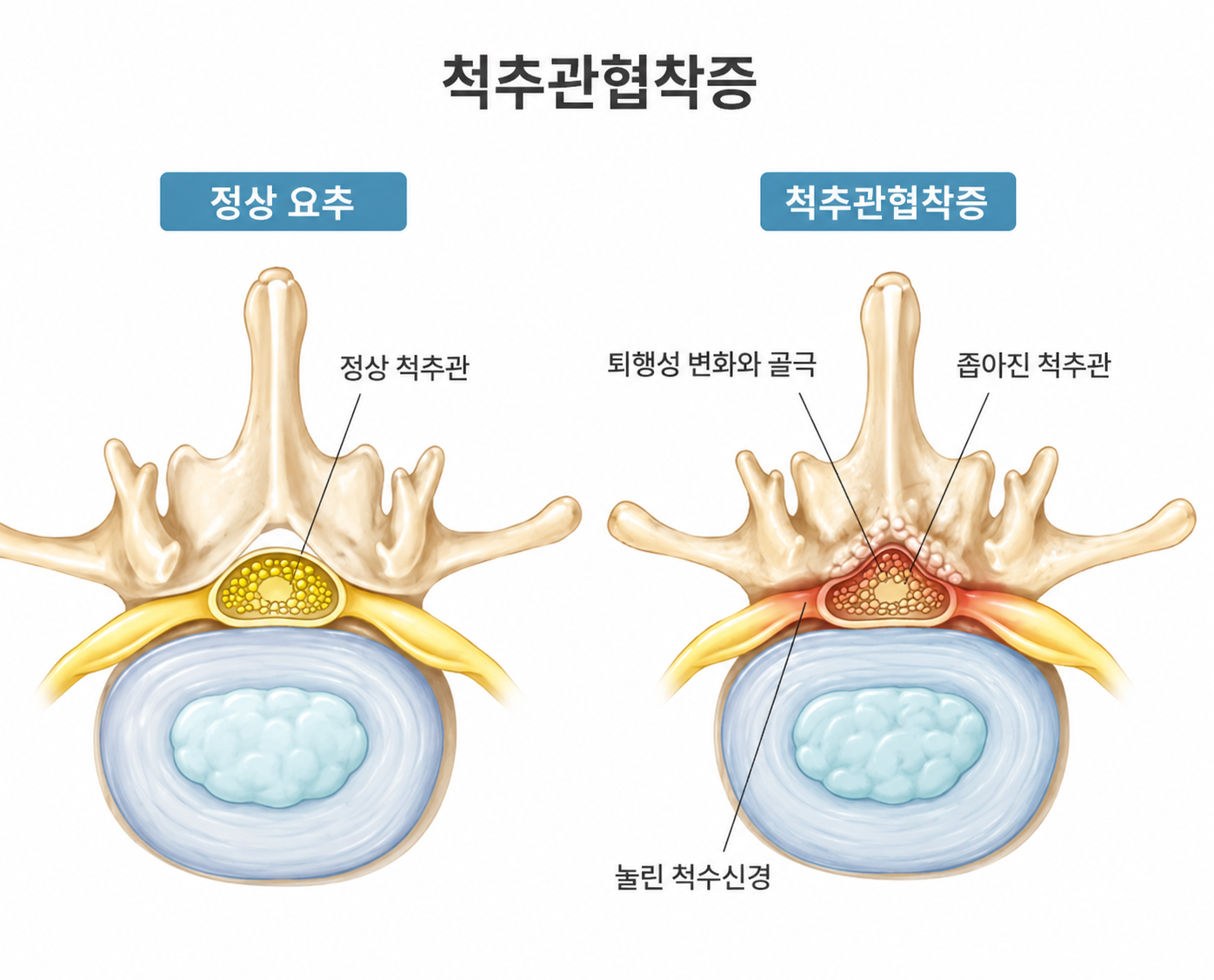
Spinal stenosis can be described as a condition in which the space inside the spine through which nerves pass narrows, causing nerve compression. Symptoms may develop as structures surrounding the spine thicken or narrow along with degenerative changes. Although it may be more common from middle age onward, the rate of symptom progression can vary depending on lifestyle habits and posture.
If you have these symptoms, consider this possibility
- Cases where walking for a long time is difficult
- Numbness or tingling in the legs when walking
- When it is difficult to straighten the lower back
- Cases where symptoms ease when sitting down to rest
- When buttock pain accompanies lower back pain
- If you feel weakness in your legs
Spinal stenosisMain causes of
Self-Assessment Checklist
If two or more of the following apply to you, we recommend seeking medical care.
- Reduce time spent standing for long periods
- Maintain posture that reduces strain on the lower back
- Reduce excessive use of the lower back
- Regular stretching and exercise management
Accurate diagnostic methods
- 1Checking pain patterns and movement
- 2Checking for changes while walking
- 3Assessing the degree of nerve compression
- 4Assessing the extent of difficulty with daily activities
- 5Imaging tests such as X-rays or MRI, if needed
Spinal stenosis Nonsurgical treatment
After an accurate diagnosis, Dongmyo Asan Orthopedic Clinic first recommends nonsurgical treatments that may help improve your condition without surgery. Depending on the patient's condition, the treatments below are provided individually or in combination.
Frequently Asked Questions
Q. Why does walking become more difficult with spinal stenosis?
A. Nerve compression may worsen when walking, and accurately assessing the current condition may be important.
Q. Can spinal stenosis also be treated nonsurgically?
A. Depending on the condition, there may be cases where treatment focused on nonsurgical options can be considered first.
Q. How do lumbar disc herniation and spinal stenosis differ?
A. Symptoms may be similar, but pain patterns and the nature of nerve compression may differ.
Q. Does everyone develop spinal stenosis as they age?
A. Degenerative changes may play a role, but this can vary depending on lifestyle habits, posture, and other factors.
Care from medical professionals who previously served as university hospital professors
Spinal stenosisAn accurate diagnosis is paramount for this condition. At Dongmyo Asan Orthopedic Clinic, we identify the cause of pain accurately through a thorough medical history and detailed examinations, then recommend the most appropriate nonsurgical treatment for each patient.
Near Dongdaemun, Dongmyo, Sinseol-dong, Bomun-dong, and Sangwangsimni Spinal stenosis If you are looking for medical care
Dongmyo Asan Orthopedic Clinic is a 3-minute walk from Dongmyo Station, making it convenient to visit from Dongdaemun, Sinseol-dong, Bomun-dong, Sangwangsimni, Changsin-dong, and Jongno-gu. Medical staff who formerly served as university hospital professors personally Spinal stenosis We provide medical care and recommend nonsurgical treatment first after an accurate diagnosis.
Spinal stenosis, start with an accurate diagnosis
Our medical team, with experience as university hospital professors, with thorough explanations
We prioritize recommending only necessary nonsurgical treatments.