Scoliosis Treatment at a Dongdaemun Orthopedic Clinic: An evaluation may be needed if your spine appears curved.
If your shoulders are at different heights or your waistline looks asymmetrical, you may also need to be assessed for possible scoliosis.
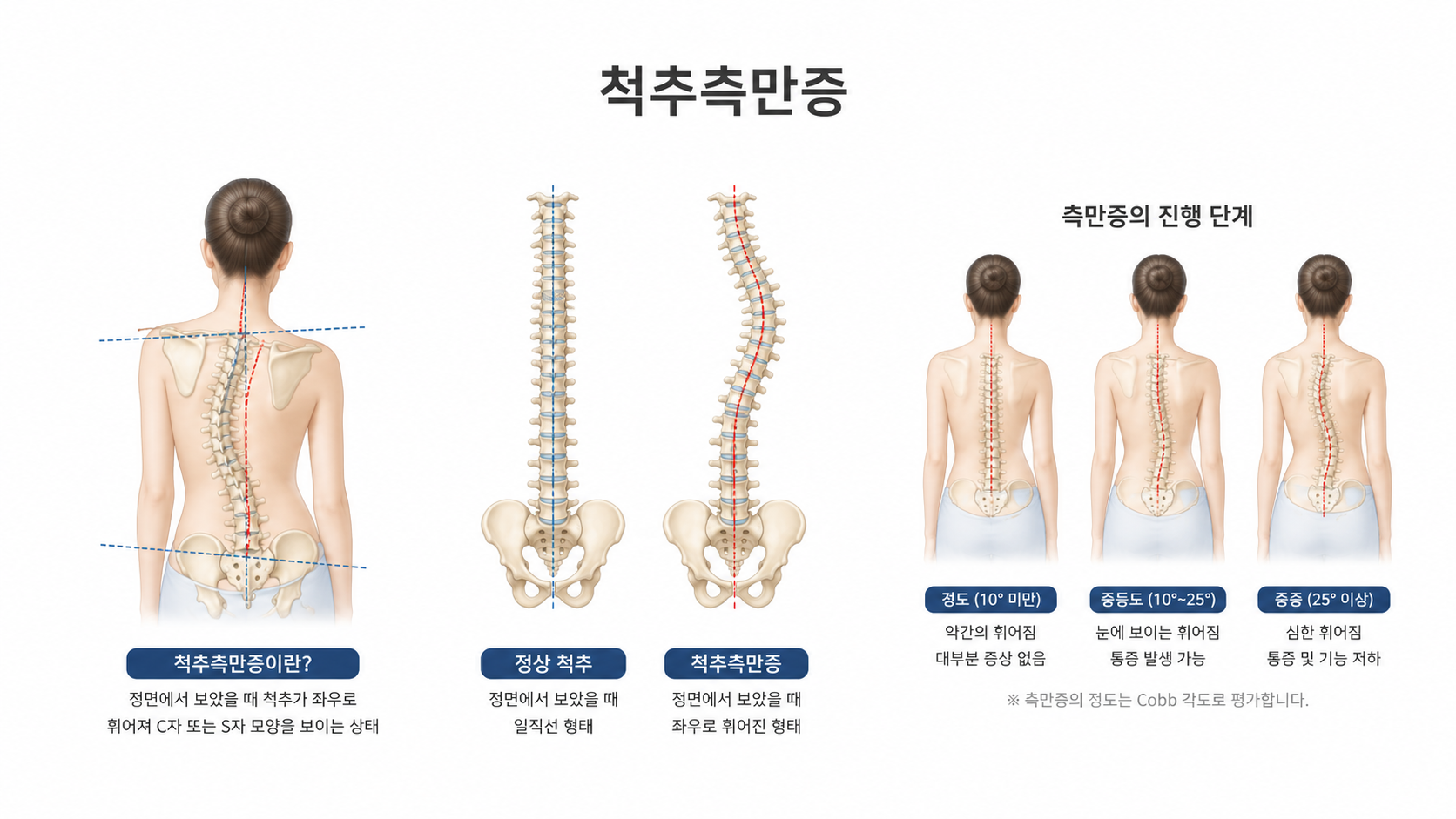
If you notice uneven shoulder heights, a pelvis that appears tilted to one side, or one side of your back protruding when looking in a mirror, it may be necessary to check for possible scoliosis as well. A sideways curvature of the spine may be found, particularly in growing adolescents or adults with poor posture.
Some patients visit a Dongdaemun orthopedic clinic with symptoms such as "One side of my child's back looks more prominent," "One shoulder looks lower when my child wears a school uniform," or "One side of my lower back hurts when I sit for a long time." Scoliosis can sometimes be painless, which may delay its detection, but accurately assessing how far it has progressed may be important.
Scoliosis can be described as a spinal deformity in which the spine curves into a C or S shape when viewed from the front. It may progress rapidly during growth and can cause postural imbalance or pain even in adulthood, so an accurate assessment of the condition may be important.
If you have these symptoms, consider this possibility
- Cases where the shoulders are at different heights
- If your pelvis or waistline is asymmetrical
- When one side of the back appears to protrude
- Cases where one side of the lower back hurts during prolonged sitting
- When clothing hangs unevenly to one side
- Cases where breathing feels difficult when symptoms are severe
ScoliosisMain causes of
Self-Assessment Checklist
If two or more of the following apply to you, we recommend seeking medical care.
- Maintaining proper posture
- Exercise both sides of the body evenly
- Reduce time spent sitting for long periods
- Stretching regularly
- Getting Regular Posture Checks
Accurate diagnostic methods
- 1Assessment of Posture and Shoulder and Pelvic Heights
- 2Forward Bend Test (Adam’s Test)
- 3Cobb angle measurement using X-rays
- 4Checking growth plate status (for adolescents)
- 5Assessment of the likelihood of scoliosis progression
Nonsurgical treatment for scoliosis
After an accurate diagnosis, Dongmyo Asan Orthopedic Clinic first recommends nonsurgical treatments that may help improve your condition without surgery. Depending on the patient's condition, the treatments below are provided individually or in combination.
Frequently Asked Questions
Q. Why is scoliosis common in adolescents?
A. Spinal deformity may progress as height increases rapidly during the growing years.
Q. Is treatment necessary even without pain?
A. Depending on the degree of progression, monitoring and management may be necessary even without pain.
Q. Can scoliosis also be treated without surgery?
A. Depending on the angle of curvature and the degree of progression, nonsurgical management may be considered first in some cases.
Q. Can scoliosis continue to progress in adulthood?
A. Changes may occur even after growth is complete, depending on posture or muscle imbalances.
Care from medical professionals who previously served as university hospital professors
ScoliosisAn accurate diagnosis is paramount for this condition. At Dongmyo Asan Orthopedic Clinic, we identify the cause of pain accurately through a thorough medical history and detailed examinations, then recommend the most appropriate nonsurgical treatment for each patient.
Near Dongdaemun, Dongmyo, Sinseol-dong, Bomun-dong, and Sangwangsimni Scoliosis If you are looking for medical care
Dongmyo Asan Orthopedic Clinic is a 3-minute walk from Dongmyo Station, making it convenient to visit from Dongdaemun, Sinseol-dong, Bomun-dong, Sangwangsimni, Changsin-dong, and Jongno-gu. Medical staff who formerly served as university hospital professors personally Scoliosis We provide medical care and recommend nonsurgical treatment first after an accurate diagnosis.
Scoliosis, start with an accurate diagnosis
Our medical team, with experience as university hospital professors, with thorough explanations
We prioritize recommending only necessary nonsurgical treatments.